Autor: Bluem Team

  • The Future of Online Identification: Secure & User-Friendly

    Die Zukunft der Online-Identifizierung: sicher und benutzerfreundlich

    We are doing more and more online: shopping, banking, and even important tasks such as getting a mortgage or registering for an event. However, these developments also bring new challenges. How can you as a business owner be sure that the person on the other side of the screen is truly who they say they are? And how do you ensure that this process remains safe and user-friendly?

    Online identification is the solution and forms the backbone of the modern digital economy. Services like iDIN and Checkin.com make it possible to verify identities reliably.

    Why online identification is becoming increasingly important

    With the growth of digital services, the need for secure and reliable authentication is also increasing. A copy of a passport is often vulnerable to fraud and phishing. Moreover, consumers want convenience: they expect quick access without endless forms or complexity. The presence of the user is no longer required – everything can be handled digitally in one seamless flow.

    Online identification services solve these problems by:

    • Security: Strong authentication prevents unauthorized access.
    • Privacy: Data is only shared with the user’s consent.
    • Speed: Simplifies processes and ensures an efficient user experience.
    • Certainty: Provides reliable verification of identities, giving both businesses and users confidence in the process.

    iDIN: The pioneer in secure online identification

    iDIN, developed by Currence, is one of the most widely used online identification services in the Netherlands. It uses the trusted login methods of banks, providing a high level of security and reliability.

    How does iDIN work?

    • The user selects iDIN as the identification method in an online environment.
    • Through their bank environment, the consumer logs in.
    • The consumer grants permission to share personal data.
    • The bank confirms the identity and shares this data securely with the provider, only with the user’s consent.

    With applications such as age verification (for example, when selling alcohol) and account creation, iDIN is already a proven solution. It provides entrepreneurs certainty about customer data and meets legal requirements.

    ID-Scanning: A Reliable Method for Online Identification

    ID-Scanning is an online identification method using a scan or photo of your identity document (such as a passport, driver’s license, or ID card). This approach is ideal for applications where a high level of certainty about identity is required, such as at financial institutions, landlords, or other services.

     How does ID-Scanning work?

    With ID-Scanning, identity documents can be digitally captured and checked, giving businesses assurance about their customers’ identities. The process begins with uploading a clear digital copy of an identity document, such as a passport, ID card, or driver’s license. The authenticity of the document is then analyzed using advanced technology, including artificial intelligence (AI) and machine learning. This technology checks security features such as watermarks and holograms and compares the data with relevant databases.

    If necessary, an additional manual review by a specialist can be conducted to identify irregularities or eliminate doubt. Thanks to this combination of automation and expert control, ID-Scanning offers a secure and efficient way to verify identities, providing confidence for both businesses and users. ID-Scanning is an efficient and safe method for verifying identities and is widely used in various sectors.

    What does this mean for your business?

    For entrepreneurs, it is clear: online identification is not a luxury but a necessity. Whether you work in e-commerce, healthcare, or finance, reliable and secure identification strengthens your customers’ trust and protects your business against risks.

    With identification solutions like iDIN and Checkin.com, you can easily adapt to this trend. Invest now in the future of online identification and prepare your business for a safe and customer-friendly digital world.
  • Wie man Ihr Unternehmen 2025 digitalisiert

    Wie man Ihr Unternehmen 2025 digitalisiert

    The Advantages of Digitalization

    1. Increased Productivity

    One of the main reasons for companies to digitalize is the gain in productivity. According to the McKinsey report, 56 percent of companies indicate that integrated digital technologies have significantly improved their work processes. By automating processes such as inventory management, customer service, and administration, organizations can maximize their resources. Especially in sectors like retail and business services, these improvements are significant.

    1. Better Customer Orientation

    Alongside productivity, digitalization enables companies to serve their customers better. With advanced data analysis tools, businesses can better understand and respond to customer behavior. More than 62 percent of companies in the retail sector reported that digital technologies helped them personalize customer interactions and increase loyalty.

    Challenges of Digitalization

    1. Lack of Qualified Personnel

    A shortage of skilled personnel remains a major challenge. The study reveals that 24 percent of companies struggle to find employees with the right digital skills. Smaller companies particularly suffer from this, as they have fewer resources to attract talent.

    1. Implementation Costs

    High costs are mentioned by 19 percent of companies as an obstacle to digitalization. For smaller companies, investments in software, hardware, and training often pose a significant hurdle.

    Wie kann man mit der Digitalisierung beginnen?

    For companies that want to start digitalizing, there are various practical steps that can be implemented in the short term. Here are three ways to begin digitalizing that offer relatively simple solutions:

    Digital Payments and Direct Debits: By switching to digital payment systems, transactions can be processed more quickly and securely.

    Digital Onboarding: including ID scanning and PEP/sanction list checks, ensures quick and secure verification of new customers and employees. These automated processes reduce the risk of fraud and ensure that companies meet compliance requirements.

    Digital Signing: Implementing digital signatures speeds up the approval process for documents and contracts. Additionally, digitalizing contracts simplifies and secures contract management and storage.

    Fazit

    Digitalization in 2025 is not only about technology but also about strategy. By choosing the right tools and partners, companies can tackle both the opportunities and challenges of digitalization. Companies that invest timely in digital transformation lay the groundwork for a competitive and future-proof organization.

    Source: McKinsey & Company Digital Strategy Insights 2024

  • 4 Werkzeuge, die jeder Personalabteilung 2025 zur Verfügung stehen werden

    4 Werkzeuge, die jeder Personalabteilung 2025 zur Verfügung stehen werden

    The world of Human Resources is changing rapidly. What was once an administrative role is now a strategic function crucial to an organization’s success. Smart technology plays a key role in this transformation. With the right tools, you can work more efficiently and provide a unique employee experience. Bluem develops innovative solutions that meet the needs of modern HR teams. Here are four essential tools that will elevate your HR department.

    1. iDIN: Secure and Fast Identification

    Identifying employees, especially during onboarding, can be a time-consuming process. iDIN simplifies this by enabling secure and user-friendly digital identification. No more hassle with physical documents; everything flows smoothly and completely online.

    Benefits of iDIN:

    • Accelerate onboarding with digital identification.
    • Reduce paperwork and contribute to a sustainable workflow.
    • No need to ask for a passport copy.
    • Secure sensitive processes like contract signing.
    1. Real-Time IBAN-Name Check: Eliminating Payment Errors

    Entering bank details is error-prone and can lead to costly problems. The Real-Time IBAN-Name Check prevents these risks by instantly verifying if the data is correct. This minimizes errors and increases payment reliability.

    What does this tool offer?

    • Automatic verification of bank details without extra effort from employees.
    • Reduce risks of fraud and incorrect payments.
    • Save time by eliminating manual checks.
    • Bank card copy unnecessary.
    1. Scrive eSign: Smart and Digital Signing

    Signing documents no longer has to be a time-consuming task. With Scrive eSign, you can have contracts and other important papers digitally signed, legally binding and compliant with international standards.

    Why choose digital signing?

    • Reduce administrative hassle and make the process more efficient.
    • Work flexibly, even when participants are not physically present.
    • Ensure seamless onboarding, even remotely.
    1. PEP and Sanction List Checking: Fully Compliant Working

    In sectors where regulations play a major role, such as financial services, it is crucial to screen candidates. With Bluem’s automated PEP and Sanction List Checking, you ensure new employees comply with anti-money laundering laws and other requirements, ensuring they do not appear on a sanctions list.

    This tool offers:

    • Immediate screening on international sanctions lists and PEPs.
    • Real-time insights to timely signal risks.
    • Assurance that you comply with all laws and regulations.

    Transform the HR Department

    Efficiency, security, and compliance are the pillars of a modern HR strategy. With tools like iDIN, the Real-Time IBAN-Name Check, Scrive eSign, and PEP and Sanction List Checking, you can digitize outdated processes, minimize risks, and provide a streamlined employee experience.

    Bluem’s solutions help you be less dependent on paperwork and manual actions, optimally preparing your HR department for the future and making a lasting impression on employees and candidates.

  • KYC – was ist das und warum ist es wichtig?

    KYC – was ist das und warum ist es wichtig?

    In recent years, KYC (Kennt Ihren Kunden) has evolved into a crucial business process within organizations. The aim? To thoroughly understand customers in order to minimize risks of financial crime and safeguard the integrity of the financial system.

    What is KYC?

    KYC, or “know your customer,” refers to processes by which financial institutions verify the identity of their clients and assess potential risks. Through thorough investigation, institutions can determine if a client is involved in criminal activities, such as money laundering, fraud, or financing terrorism. This process not only protects the financial institution but also the broader financial system.

    The KYC process includes:

    • Identification and verification of clients and any ultimate beneficial owners (UBOs).
    • Creating a complete customer profile.
    • Determining the purpose and nature of the customer relationship.
    • Identifying and assessing risks.
    • Analyzing transactions.
    • Accepting or rejecting clients based on research findings.

    KYC and CDD: What is the difference?

    KYC serves as an overarching principle that encompasses Customer Due Diligence (CDD) and Anti-Money Laundering (AML). Although the terms are often used interchangeably in practice, CDD specifically focuses on customer due diligence within the broader KYC framework.

    Importance of KYC

    Financial institutions such as banks and insurers are legally required to protect their services from criminal use. This means they must recognize and assess potential risks to prevent misuse.

    Complying with KYC rules not only contributes to the integrity of the financial system but also protects the reputation of institutions. Furthermore, it fosters trust in the economy, which is essential for stability.

    Legislation and Obligations

    In the Netherlands, KYC obligations are enshrined in various laws, including:

    1. The Anti-Money Laundering and Anti-Terrorist Financing Act (Wwft): Focuses on detecting and reporting unusual transactions.
    2. The Sanctions Act: Prevents business relations with sanctioned parties.
    3. The Financial Supervision Act (Wft): Provides oversight of the financial sector.

    This legislation is based on international recommendations from the Financial Action Task Force (FATF). Financial institutions are required to report unusual transactions to the Financial Intelligence Unit (FIU).

    Enforcement and Penalties

    In recent years, various institutions have been fined for shortcomings in KYC processes. For example, ING paid a settlement of 775 million euros for negligence in money laundering prevention, and Rabobank was fined a million euros for inadequate customer records.

    The Solutions by Bluem

    Bluem understands the challenges of KYC and offers various solutions to make the process more efficient, secure, and customer-friendly.

    Verifying the accuracy of an IBAN number is essential to prevent payment issues. With Bluem’s IBAN-Name Check, you can quickly and easily ensure that the account holder’s name matches the specified IBAN number. This reduces the risk of fraudulent transactions and mistakes.

    Bluem offers digital verification options allowing you to quickly and reliably confirm the identity of new clients. This helps meet legal requirements and reduces the risk of identity fraud.

    Protect vulnerable individuals from unwanted situations and contracts. The person should not independently enter into agreements or make financial decisions. In practice, it involves individuals suffering from mental disorders, overspending, or addictions. With Bluem’s CCBR check, a company prevents issues later on, including the financial damage associated with reversing all (null) actions.

    To comply with legal obligations related to anti-money laundering practices, it is crucial to conduct thorough customer checks. Bluem’s AML solution automates this process by screening clients against sanction lists, PEP lists (Politically Exposed Persons), and other relevant data sources. This helps companies to comply with regulations and minimize integrity risks.

    Fazit

    KYC is indispensable in the fight against financial-economic crime. For financial institutions, this not only means fulfilling legal obligations but also contributing to a reliable and secure financial system.

  • Warum immer mehr Unternehmen auf iDIN umsteigen

    Warum immer mehr Unternehmen auf iDIN umsteigen

    With the growth of digital services, it is becoming increasingly important for entrepreneurs to quickly and reliably identify customers. At the same time, consumers expect this process to be safe and user-friendly. iDIN offers an innovative solution that meets these demands perfectly. Why are more and more companies choosing iDIN? And what makes this identity service indispensable for you as an entrepreneur?

    Was ist iDIN and how does it work?

    iDIN is an online identification service that uses the secure login methods of banks. Users can confirm their identity and share their personal data with companies via iDIN, without having to create new accounts. The strength of iDIN lies in the trust users already place in their bank, combined with a simple usage process.

    How does it work?

    1. The user chooses iDIN as the identification method at an online service or webshop.
    2. Through a trusted login environment of their own bank (like with online banking), the user confirms their identity.
    3. Data such as name, address, and date of birth is securely shared with the company, exclusively with the explicit consent of the user.

    Why do companies choose iDIN?

    1. Assurance of customer identity

    As an entrepreneur, you want to be sure that your customers are who they claim to be. Whether it involves age verification, identity checks during sensitive transactions, or account creation – iDIN provides a simple and reliable solution. This way, your company also directly complies with legal requirements like for the sale of alcohol or other age-restricted products.

    For example: PostNL is testing a system where customers must prove they are 18+ with iDIN for alcohol delivery. This makes compliance with laws and regulations simple and reliable.

    1. User-friendliness for consumers

    A smooth customer process is essential for conversion and customer satisfaction. With iDIN, consumers do not have to create new passwords or accounts. They use their trusted banking environment to verify their identity. This lowers barriers and ensures a better customer experience.

    1. Protection against fraud

    iDIN uses strong authentication through the security systems of banks. This minimizes the risk of fraud and unauthorized access. For entrepreneurs, this means less risk and a higher degree of confidence in customer data.

    1. Privacy and compliance

    iDIN is designed with consumer privacy in mind. Companies receive only the data necessary for a specific transaction, and consent is explicitly given by the user. This makes iDIN not only secure but also fully compliant with the General Data Protection Regulation (GDPR).

    Applications of iDIN

    The versatility of iDIN identification makes it suitable for various sectors. Some examples:

    • Age verification: Sale of alcohol, tobacco, or other age-restricted products.
    • Account creation: Direct, secure registration of new users.
    • Financial services: Confirming identity for loan applications or insurance.
    • Football clubs: For professional football clubs, it is important to know exactly to whom they are selling a club card.

    How does iDIN work?

    1. Choose iDIN as identification method: When you want to identify yourself on a website that supports iDIN, select the iDIN option. This could be at an online store, government service, or insurance company.
    2. Select your bank: After choosing iDIN, you are redirected to a screen where you can select your bank. These are usually the major Dutch banks like ING, Rabobank, ABN AMRO, etc.
    3. Log in at your bank: Then log in at your bank as you normally would for online banking. This can be via the bank’s app on your smartphone or with a physical security code.
    4. Confirm your identity: Once logged in, your bank confirms your identity to the service provider where you want to identify. Importantly, your bank does not share sensitive data like your account number or balance with the service provider; only the confirmation of your identity is forwarded.

    Ready for the next step?

    With iDIN, your business becomes more efficient, secure, and customer-friendly. Whether it’s about complying with legal requirements, increasing conversion rates, or improving your customer relationship – with iDIN, you bring a proven solution into your house.

    Do you want to be prepared as an entrepreneur for the future? Then iDIN is the choice to focus on trust and safety in your services.

  • Warum immer mehr Organisationen mit der digitalen Autorisierung für Sammlungen beginnen

    Warum immer mehr Organisationen mit der digitalen Autorisierung für Sammlungen beginnen

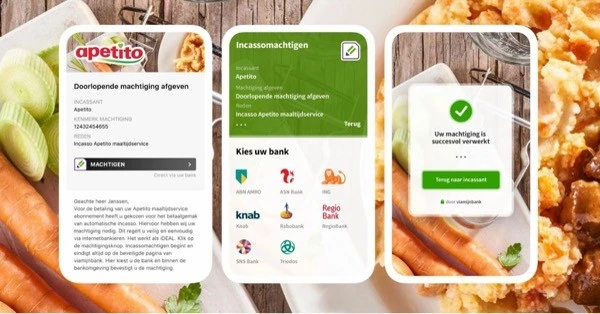
    Organisationen suchen ständig nach Möglichkeiten, ihre Prozesse zu optimieren. Die digitale Lastschriftausweisung ist eine Lösung, die zunehmend angenommen wird. Sie ermöglicht es Unternehmen und Kunden, Berechtigungen für wiederkehrende Zahlungen oder Autorisierungen schnell und einfach zu vergeben. Aber was macht diesen Ansatz so attraktiv und warum wechseln so viele Organisationen auf diese Methode?

    Was ist Digitaler Direktausweisungsautorisierung?

    Die digitale Lastschriftausweisung ist ein Online-Verfahren, mit dem ein Kunde einer Organisation die Erlaubnis gibt, Zahlungen automatisch einzuziehen. Dieses Verfahren ähnelt einem iDEAL-Transaktionsvorgang: Der Kunde wählt seine Bank aus, gibt seine Zustimmung ab und die Autorisierung wird sofort wirksam. Die traditionelle Papierarbeit, die früher mit Autorisierungen verbunden war, gehört nun der Vergangenheit an.

    Vorteile für Organisationen

    Stets mehr Unternehmen erkennen die Vorteile der digitalen Autorisierung. Ein zentraler Vorteil ist die Zeitersparnis. Während bei traditionellen Autorisierungen aufgrund der Postversendung, der Verarbeitung und manuellen Überprüfungen Tage oder sogar Wochen benötigt werden können, kann eine digitale Autorisierung in nur wenigen Minuten durchgeführt werden.

    Darüber hinaus bietet die digitale Autorisierung einen höheren Grad an Genauigkeit. Da die Daten direkt über die Bank des Kunden eingegeben und verarbeitet werden, werden Fehler wie falsche Kontonummern oder fehlende Informationen praktisch eliminiert. Dies verhindert administrative Probleme und verbessert die Qualität der Kundenbeziehung.

    Ein weiterer großer Vorteil ist die Compliance. Die digitale Lastschriftausweisung entspricht den gesetzlichen Anforderungen und Richtlinien zur automatischen Lastschrift und bietet Unternehmen die Sicherheit, dass sie korrekt und sicher arbeiten.

    Verbesserte Kundenerfahrung

    Neben den Vorteilen für Unternehmen bietet die digitale Autorisierung auch einen besseren Kundenerlebnis. Der Prozess ist einfach, schnell und sicher. Kunden müssen sich keine Formulare ausfüllen oder auf eine Bestätigung per E-Mail warten. Alles wird online erledigt, was den Wünschen des modernen Verbrauchers entspricht.

    Darüber hinaus bietet der digitale Ansatz Transparenz: Die Kunden können sofort erkennen, welche Firma die Autorisierung verarbeitet und zu welchem Zweck. Dies stärkt das Vertrauen in den Prozess.

    Anwendung in allen Branchen

    Die digitale Autorisierung ist nicht auf einen bestimmten Sektor beschränkt. Unternehmen in verschiedenen Branchen profitieren von dieser modernen Methode – von Energieversorgern und Fitnessstudios bis hin zu gemeinnützigen Organisationen und Versicherungsunternehmen. Selbst kleine Unternehmer können problemlos auf die Vorteile umsteigen und davon profitieren.

    Die Zukunft der Genehmigungen

    Mit der zunehmenden Digitalisierung ist die digitale Autorisierung ein logischer Schritt. Sie macht Geschäftsabläufe effizienter, bietet Kunden mehr Komfort und passt zu den Trends schneller und zuverlässiger Online-Dienste. Mehr Organisationen erkennen, dass der Wechsel zu digitaler Autorisierung keine Luxusausstattung ist, sondern eine Notwendigkeit, um wettbewerbsfähig zu bleiben.

    Die Vorteile der digitalen Autorisierung per Lastschrift mit Bluem

    Bluem macht die digitale Lastschriftausweisung für Unternehmen einfach und effizient. Mit einer benutzerfreundlichen Lösung und verschiedenen praktischen Funktionen bietet Bluem alles, was Sie für die Optimierung Ihrer Zahlungsverfahren benötigen.

    • Schnell und sofort einsatzbereit

    Mit Bluem, Sie können sofort beginnen. Ob Sie einen Webshop betreiben oder Geschäftsdienstleistungen anbieten – die Integration digitaler Autorisierungen funktioniert problemlos über API oder Plugin. Auf diese Weise können Sie Autorisierungsmöglichkeiten Ihrer Plattform einfach hinzufügen.

    • Flexible Integrationsmöglichkeiten

    Wir verstehen, dass jede Firma einzigartig ist. Deshalb können Sie aus mehreren Verbindungsmöglichkeiten wählen, wie z. B. einer API, einem Plugin oder einem Online-Dashboard. So können Sie ganz einfach die digitale Kommunikation optimal an Ihre Bedürfnisse anpassen. Autorisierung für Direktlasten zu Ihren bestehenden Systemen und Arbeitsabläufen.

    • Automatisierte Erinnerungen

    Das System von Bluem unterstützt Unternehmen bei der Verwaltung von Zahlungen, indem automatisch Erinnerungen gesendet werden. Kunden werden rechtzeitig informiert, wenn eine Zahlungsfrist naht oder wenn eine Zahlung versäumt wurde. Dies hilft, Zahlungsverzug zu verhindern und einen gesunden Cashflow zu fördern.

    • Persönliche Kommunikation

    Sie können die Autorisierungsempfehlungen vollständig an Ihren eigenen Markenstil und Ihre eigene Tonart anpassen. Dadurch entsteht ein erkennbares und professionelles Erscheinungsbild, das das Vertrauen der Kunden erhöht.

    • Komplettes Reporting

    Ein genauer Blick ist entscheidend für einen reibungslosen Zahlungsverfahren. Bluem bietet umfangreiche Berichtsfunktionen, die einen vollständigen Überblick über aktive und abgeschlossene Autorisierungen bieten. Auf diese Weise können Sie administrativ effizient arbeiten und besser auf das Zahlungsverhalten Ihrer Kunden reagieren.

    • Autorisationsseite in Ihrer eigenen Form

    Ein zuverlässiger Auftritt ist in der Zahlungsumgebung entscheidend. Mit Bluem können Sie die Autorisierungsseite individuell an Ihr eigenes Markenimage anpassen. Kunden erkennen sofort, dass sie mit einer vertrauenswürdigen Partei zu tun haben, was die Wahrscheinlichkeit erfolgreicher Autorisierungen erhöht.

    Fazit

    Mit den Lösungen von Bluem können Sie die Autorisierung für elektronische Lastschriften problemlos in Ihre Geschäftsabläufe integrieren. Sie bieten Ihren Kunden eine sichere und effiziente Erfahrung und profitieren selbst von einem optimierten und zuverlässigen Prozess. Wählen Sie Bluem und profitieren Sie von Ihren digitalen Zahlungsmöglichkeiten optimal aus.

  • Wie schütze ich meine Organisation vor Online-Betrug?

    Wie schütze ich meine Organisation vor Online-Betrug?

    Fraud remains a stealthy danger for companies in the Netherlands. Although many organizations have confidence in their own measures, research points to a hard reality: fraud affects an overwhelming majority of businesses and causes serious financial damage.

    Fraud Statistics in 2023/2024

    The annual fraud research shows that no less than 69% of companies in 2023/2024 faced fraud attempts. In 91% of the cases, this led to actual harm. These figures make clear that fraud is not a marginal issue but a widespread risk. Moreover, the financial consequences are significant:

    • 55% of the damage cases resulted in a loss of more than €50,000.
    • 16% of the damage cases exceeded €200,000.
    • In cases of internal fraud, 2% of companies suffered more than €1 million in damage, while for external fraud, this rose to 5%.

    These figures underline that the impact of fraud is not only widespread but also poses a serious threat to the financial health of organizations.

    Source: Allianz Trade.

    The Dangerous Gap between Perception and Reality

    A notable conclusion from the research is the difference between how companies perceive fraud and its actual impact. 95% of companies are satisfied with their existing measures and security protocols. Yet, a majority indicates that fraud as a threat is growing. However, many organizations continue to believe they are not at great risk themselves.

    This sense of security is often unjustified. The figures show that the chance of becoming a victim is significant, with potentially devastating consequences. This contrast between confidence in self-measures and the real risks points to a false sense of security.

    Uninsured against Fraud: A Risk Many Companies Take

    Another concerning aspect is that less than half of the companies have insurance against fraud. As a result, organizations often rely entirely on their own reserves when affected. This can be especially disastrous for small and medium-sized businesses, as they often have fewer resources to absorb such losses.

    Tools to Prevent Fraud

    While fraud can be difficult to detect due to sophisticated methods, there are various measures companies can take to reduce their risk:

    1. IBAN-Name-Überprüfung: The IBAN-Name Check compares the beneficiary’s name with the name known by the bank for the specified IBAN number. This helps prevent payments to incorrect accounts and minimizes the risk of fraud and errors when transferring money.
    2. Identitätsüberprüfung: Identity verification ensures that a customer’s identity is checked securely and reliably. This can be done through a combination of documents, biometric data, and other verification methods. This way, you know who you are dealing with, and the chance of fraud is reduced because you can verify the customer’s authenticity and prevent unauthorized access.
    3. Digital Authorization: Digital authorization offers extra assurance when granting authorization, preventing unauthorized debits. By using legally valid digital authorization through the beneficiary’s bank, you reduce the chance of fraud. This adds an extra layer of control because only verified authorizations are accepted.

    Fazit

    Fraud is a growing danger that companies should not underestimate. Trust in existing measures often proves unjustified, and the financial damage can be substantial. Companies that invest in prevention and protection now can better equip themselves against this threat and avoid becoming one of the victims losing millions annually. Bluem offers a comprehensive package of services, such as IBAN-Name check, IDIN, ID-scanning, and direct debit authorization, which reduce organizations’ risk of fraud.

  • Die Auswirkungen der Digitalisierung auf Unternehmen

    Die Auswirkungen der Digitalisierung auf Unternehmen

    Digitalisierung ist eine der treibenden Kräfte des Wachstums, der Effizienz und der Innovation. Nach jüngsten Studien des CBS haben fast 91 Prozent der niederländischen Unternehmen in den letzten Jahren Digitalisierungsinitiativen unternommen. Die Hauptmotivation dafür sind die erwarteten Produktivitäts- und Effizienzsteigerungen. Allerdings ist die Digitalisierung nicht ohne Herausforderungen. Viele Unternehmen stellen jedoch Hindernisse wie hohe Kosten und ein Mangel an qualifiziertem Personal vor.

    Digitalisierung und Produktivitätssteigerung

    Die Steigerung der Produktivität ist ein wichtiger Grund dafür, dass Unternehmen weiter digitalisieren. Rund 53 Prozent der Unternehmen nannten dies als Hauptgrund. Durch die Nutzung von ICT und digitalen Technologien können sie ihre Arbeitsabläufe rationalisieren und mehr aus ihren verfügbaren Ressourcen herausholen. Größere Unternehmen scheinen am meisten davon zu profitieren: 67 Prozent der großen Unternehmen erlebten einen positiven Effekt, verglichen mit 44 Prozent der kleineren Unternehmen. In Branchen wie Einzelhandel und Dienstleistungen waren diese Auswirkungen noch deutlicher zu verzeichnen.

    Sektorspezifische Unterschiede in der Digitalisierung

    Die Ausprägung und das Ausmaß der Digitalisierung variieren je nach Branche. Einzelhändler, bei denen über 65 Prozent angaben, dass die Digitalisierung ihren Wachstum und ihre Entwicklung positiv beiträgt, gaben dies am häufigsten an. Im Informations- und Kommunikationsektor, wo 20 Prozent der Unternehmen einen signifikanten positiven Einfluss berichteten, spielt die Digitalisierung ebenfalls eine wichtige Rolle. In Sektoren wie der Gastronomie spielt die Digitalisierung hingegen eine geringere Rolle, da bei etwas mehr als 18 Prozent keine Digitalisierungsprojekte durchgeführt wurden.

    Hürden für die Digitalisierung

    Trotz der Vorteile der Digitalisierung erleben Unternehmen jedoch verschiedene Hindernisse. Die fehlende Fachkräfteausstattung ist für mehr als 20 Prozent der Unternehmen ein Hauptproblem, insbesondere in Branchen wie der Immobilienvermietung und -vermittlung. Unternehmen haben Schwierigkeiten, spezialisierte Mitarbeiter zu finden, die die digitale Transformation leiten und umsetzen können. Darüber hinaus nennen fast 18 Prozent der Unternehmen hohe Kosten als Hindernis, insbesondere für kleine Unternehmen.

    Positive Erfahrungen und Herausforderungen

    Die Digitalisierung wirkt sich nicht bei allen Unternehmen gleich stark aus. Mehr als ein Drittel der Unternehmen bemerkt kaum oder gar keine Auswirkungen ihrer digitalen Initiativen. Gleichzeitig erlebten 54 Prozent der Unternehmen in den letzten 12 Monaten einen (sehr) positiven Einfluss auf Wachstum und Entwicklung. Dies zeigt, dass die Chancen der Digitalisierung zwar vielfältig sind, die Vorteile jedoch stark von der Vorbereitung und Unterstützung eines Unternehmens in diesem Übergang abhängen.

    Wie kann man mit der Digitalisierung beginnen?

    Für Unternehmen, die in die Digitalisierung starten möchten, gibt es kurzfristig verschiedene praktische Schritte. Hier sind drei Wege, wie man beginnen kann, die relativ einfache Lösungen bieten:

    Digitale Zahlungen und Autorisierung für Direktlastschriften: Durch den Wechsel zu digitalen Zahlungssystemen können Transaktionen schneller und sicherer durchgeführt werden.

    Digitales Onboarding: einschließlich der Identitätsüberprüfung und der Überprüfung der PEP-/Sanktionslisten gewährleistet eine schnelle und sichere Verifizierung neuer Kunden und Mitarbeiter. Diese automatisierten Prozesse reduzieren das Risiko von Betrug und stellen sicher, dass Unternehmen die Compliance-Anforderungen erfüllen.

    Digitale SignaturDie Implementierung digitaler Signaturen beschleunigt den Genehmigungsprozess für Dokumente und Verträge. Darüber hinaus vereinfacht und sichert die Digitalisierung von Verträgen die Vertragsverwaltung und -speicherung.

    Fazit

    Starten Sie mit der Digitalisierung nicht kompliziert. Mit der richtigen Strategie und den richtigen Tools können Unternehmen bereits kurzfristig von den zahlreichen Vorteilen profitieren, die die Digitalisierung bietet. Dienstleistungen wie die von Bluem erleichtern die Implementierung digitaler Lösungen und ermöglichen es Unternehmen, schnell auf die sich ändernden Marktanforderungen zu reagieren und ihre Wettbewerbsfähigkeit zu stärken. Indem Sie jetzt mit der Digitalisierung beginnen, können Unternehmen auf eine Zukunft vorbereiten, in der Technologie eine zentrale Rolle in ihrem Erfolg spielt.

    Quelle: CBS & Konjunkturumfrage Niederlande